Bringing Your Biology to Work
Feb 02, 2026
By WCorp Editorial Team
#WomenAtWork #WomenInLeadership #MenopauseAtWork #Perimenopause #WorkplaceWellbeing #FlexibleWorking #EmployeeRetention #LeadershipDevelopment #WorkLifeBalance #BiologyAtWork
Working with the Body at Work: Who Burns Out First and Why
Women contribute enormous value at work, as employees, leaders, founders and decision-makers. Yet the biology that shapes women’s lives - periods, pregnancy, perimenopause, menopause and ageing - also shapes how we show up, how we lead and how long we stay.
When workplaces ignore this reality, women are left to cope alone and burn out in silence. When organisations acknowledge it and design work accordingly, women remain engaged, effective and ambitious.
Biology is a Leadership Issue
Women’s biological transitions are no longer a fringe wellbeing topic. They sit at the centre of talent retention, leadership continuity and long-term business performance.
Across a working life, women experience repeated physiological shifts: period pain, heavy bleeding and cyclical changes in mood and energy; pregnancy and fertility treatment layered on top of workload, deadlines and financial pressure; and perimenopause and menopause, which can last a decade and affect sleep, memory, temperature regulation, mood and confidence. These changes land on systems designed around a default worker who never has a cycle, never carries a pregnancy, never wakes soaked in sweat at 3am before a board meeting.
Workplace data shows women are around twice as likely as men to take time off due to stress, anxiety or depression, with older women, many of whom are navigating menopause, disproportionately affected. At the same time, a third of UK women are calling for menopause support at work. More than one in ten women in the UK are actively seeking roles that include menopause support, according to Fertifa. This points to a clear gap between what women need and what most workplaces currently offer. When organisations treat biology as irrelevant, women burn out faster. When it is treated as strategic, women stay, lead and flourish.
How Women Are Coping in the Absence of Real Support
Even without structural support, women find ways to keep going. Research on women leaders navigating menopause shows that many rely on their own strategies rather than formal support. They adjust expectations, prioritise health, lean on trusted networks and redefine success during periods of change.
This adaptation shows the depth of women’s resilience. It also exposes how much responsibility sits on individual shoulders. When even executives must privately redesign their lives to stay functional at work, it points to systems that are not doing their share.
Practical Strategies Women Use to Stay Effective
Women do not stop caring about their careers when their bodies change. What shifts is how they work. These strategies are widely discussed by clinicians, workplace researchers and women’s health experts, and are echoed in leadership commentary on perimenopause, nutrition and sustainable performance. They help women stay effective, clear‑headed and in control.
Making Sense of the Body
Understanding what is happening biologically reduces stress and restores confidence. Menstruation affects most working women: nearly four in five report symptoms such as cramps, fatigue and low mood, and more than two‑thirds say these symptoms negatively impact their work performance. Only 12% of organisations provide support for menstruation and menstrual health.
Perimenopause can start years before periods stop, and symptoms like brain fog, fluctuating energy, poor sleep or anxiety are very real. They are physiological responses to hormonal shifts, not personal weakness or poor resilience. Recognising that symptoms are rooted in biology - not a personal shortcoming - allows women to plan workloads, seek appropriate health guidance and make informed decisions.
Lifestyle choices sit alongside this. A large perimenopause survey found that 80% of women reported at least one trigger of perimenopause symptoms, with common triggers including stress, caffeine, alcohol and sugar (Health & Her report). Women described work stress and stimulants as fuelling a vicious circle of poor sleep, anxiety and brain fog. Reducing alcohol intake, moderating caffeine and avoiding frequent spikes in blood sugar from refined carbohydrates and added sugars can lessen hot flushes, night sweats, mood swings and energy crashes, which in turn supports clearer thinking at work (Health & Her; Nourish Holistic Wellbeing).
Many also adjust nutrition: prioritising protein for muscle mass, incorporating calcium and vitamin D for bone health, and reducing alcohol and refined sugar to manage energy and sleep. Research shows healthy nutrition can significantly improve symptom management during these transitions.
Communicating with Purpose
Speaking about needs can feel risky, especially in cultures that equate professionalism with invisibility. Yet clear, calm communication protects performance. Conversation starters that focus on output rather than discomfort help managers listen. Examples include flexible start times to manage disrupted sleep, control of physical environments to manage discomfort, protected focus time and remote working where helpful. Effective communication about needs helps remove the stigma around biological transitions and creates space for sustainable work.
Working with Energy, Not Against It
Energy changes across life stages. Many high‑performing women reorganise their work to match their natural rhythms: complex thinking and creative work during higher‑energy periods, routine or administrative tasks during lower‑energy periods. Working smarter with your body, rather than pushing through exhaustion, protects your performance and wellbeing over the long term.
Building Peer and Professional Support
Connection changes everything. Fertility challenges, pregnancy loss, traumatic births, perimenopause and menopause can feel isolating in workplaces that never mention them. Research on reproductive health in work shows that only about 30% of people felt very supported by employers during fertility investigations or treatment and one in five has considered leaving their job as a result.
Peer networks, mentoring circles, employee resource groups and confidential coaching with specialists like Geeta Sidhu-Robb give women places to be honest, swap practical tactics and rebuild confidence. Professional advice on hormones, nutrition, stress, sleep, and boundaries helps women turn vague “coping” into intentional, sustainable strategies.
What Forward-Thinking Organisations Are Doing Differently
What many women experience is not individual weakness but a failure of systems to recognise human biology as part of work life. Periods, pregnancy, fertility challenges, perimenopause, menopause and ageing are universal experiences. They only become disruptive when workplaces ignore them. Organisations that see biology as a strategic and leadership issue create environments where women thrive - and business thrives too.
Forward-thinking organisations are adopting practical approaches:
- Training managers on biological transitions Managers are learning to recognise and respond to reproductive and hormonal health issues without embarrassment or stigma. Simple awareness of menstrual health, pregnancy needs, and menopause symptoms improves communication and reduces hidden stress.
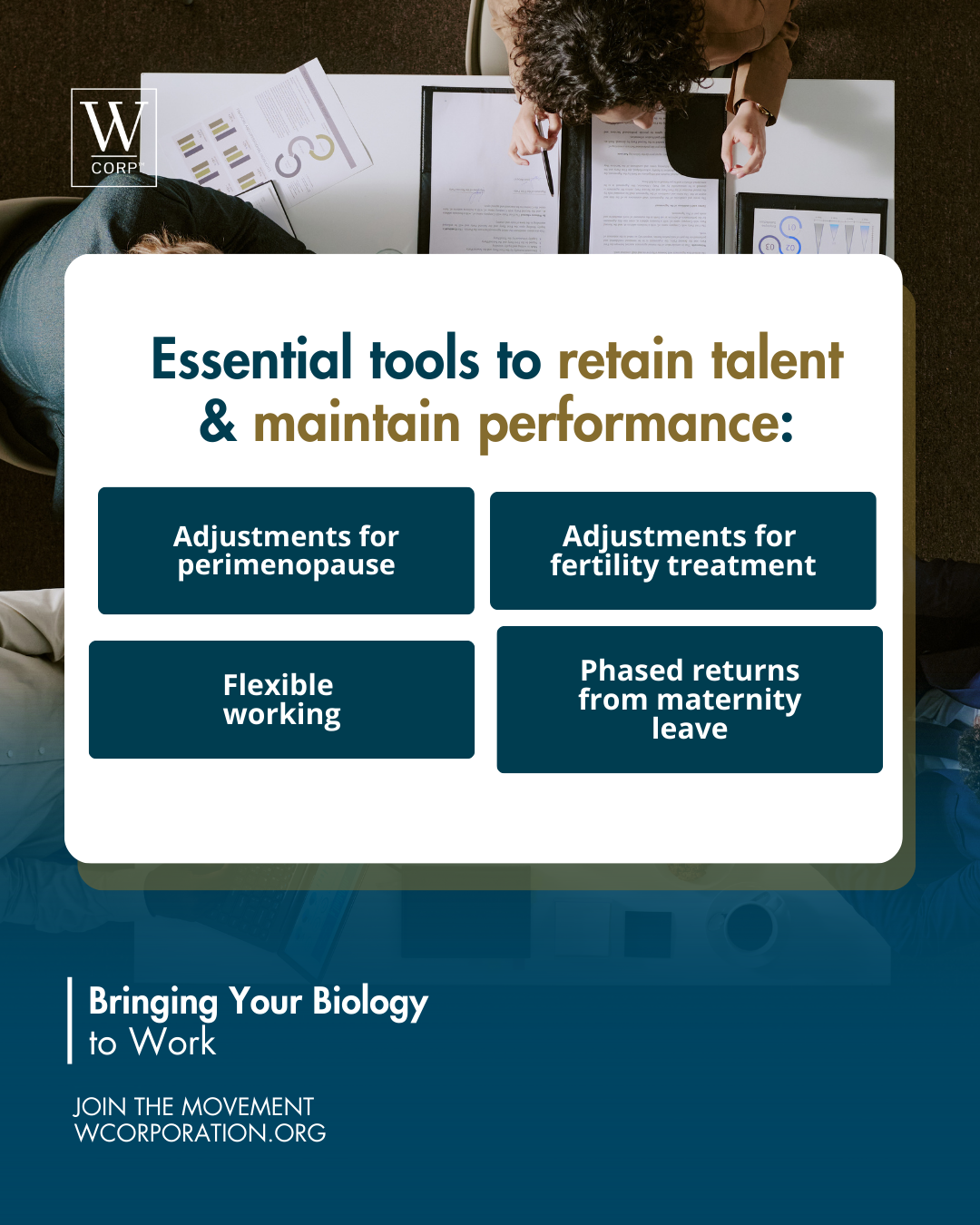
- Embedding flexibility as standard practice Flexible working, phased returns from maternity leave, and adjustments for fertility treatment or perimenopause symptoms are no longer “nice-to-have” perks. They are essential tools to retain talent and maintain performance.
- Treating biological health as a leadership and retention issue Policies that support menstrual health, pregnancy, fertility, and menopause are now recognised as central to talent retention, engagement, and productivity. Organisations that take this seriously reduce absenteeism and enhance inclusion. (CIPD)
- Collecting data on progression, attrition, and wellbeing Organisations are tracking career progression, promotions, and retention alongside age, gender, and reproductive life events. This makes disparities visible and gives leaders actionable insight to create fairer workplaces. (McKinsey & Company: Women in the Workplace 2024)
Designing Work That Lasts
Periods, pregnancy, fertility challenges, perimenopause, menopause, and ageing are predictable parts of life for half the workforce. Work designed around real human lives keeps women in the system, reduces burnout, and strengthens leadership pipelines.
Practical steps for leaders include:
- Talk openly about biological transitions in everyday language that reduces stigma.
- Offer flexibility, environmental adjustments and time for medical appointments or fertility treatment as standard practice.
- Encourage healthy foundations by normalising breaks, sleep, movement, and sustainable workloads.
- Track progression, retention and wellbeing by gender, age and life stage so that problems show up in the data, not just in exit interviews.
- Support peer networks, mentoring and access to expert advice so women do not have to hold everything alone.
When organisations honour biology, women stay longer. They lead with more empathy and clarity. They turn lived experience into practical wisdom that strengthens teams and cultures.
Work that evolves with people lasts longer. So do the women who power it.