The Pension Gap Is a Workplace Problem. It Is Time Leaders Took Ownership of It
Mar 30, 2026
By WCorp Editorial Team
March 2026
#GenderPensionGap | #WomenInLeadership | #InclusiveWorkplace | #GenderPayEquity | #WorkplaceEquality | #PensionPoverty | #CareerBreaks | #TalentRetention | #WomenFriendlyWorkplace | #WorkplaceInnovation
The Gap That Starts at Work and Ends in Poverty
Following on from last week’s blog on why women are better investors yet still retire poorer, the financial penalty facing women does not pause at the point of investment. It accumulates quietly across every decade of a woman’s working life, and the final accounting happens at retirement.
The numbers are stark. According to Scottish Widows’ Women and Retirement Report 2025, the median total private pension for women at retirement is £173,000 versus £286,000 for men. That £113,000 gap, a 32% difference, up from £100,000 the year before, is not a private financial failure. It is the compounded result of how workplaces are structured and who absorbs the cost of those structures.
The gap is widening, not closing, and the cause is hiding in plain sight. 58% of women at or near retirement have taken a career break, compared to just 12% of men. Women are 12 times more likely to take a break in their career to raise children. By age 55, one in four women have been out of work for more than five years.
Scottish Widows research published in 2025 puts this into brutal perspective. At current rates of progress, the UK remains 20 years away from closing the gender pension gap. In practical terms, the average woman is on track for £13,000 a year in retirement. The average man, £19,000.
That £5,000 annual shortfall plays out every year, for the rest of her life, against a rising cost of living. By age 60, men are expected to retire with 75% more in pension savings than women. Not 10% more. Not 20% more. Seventy-five percent.
This is not accidental. It is the predictable outcome of how work is structured.

The Caring Cost That Compounds
The root cause of the retirement crisis is not financial literacy. It is not confidence. A 2026 report by psychologist Emily Shipp of the Edinburgh Futures Institute, supported by Evelyn Partners, argues that the “confidence gap” narrative is a misdiagnosis. Half of women say investing does not feel like it is for them, compared to 38% of men. The issue is not capability. It is access, experience and systems that exclude by default. The real drivers are systemic, situational and social.
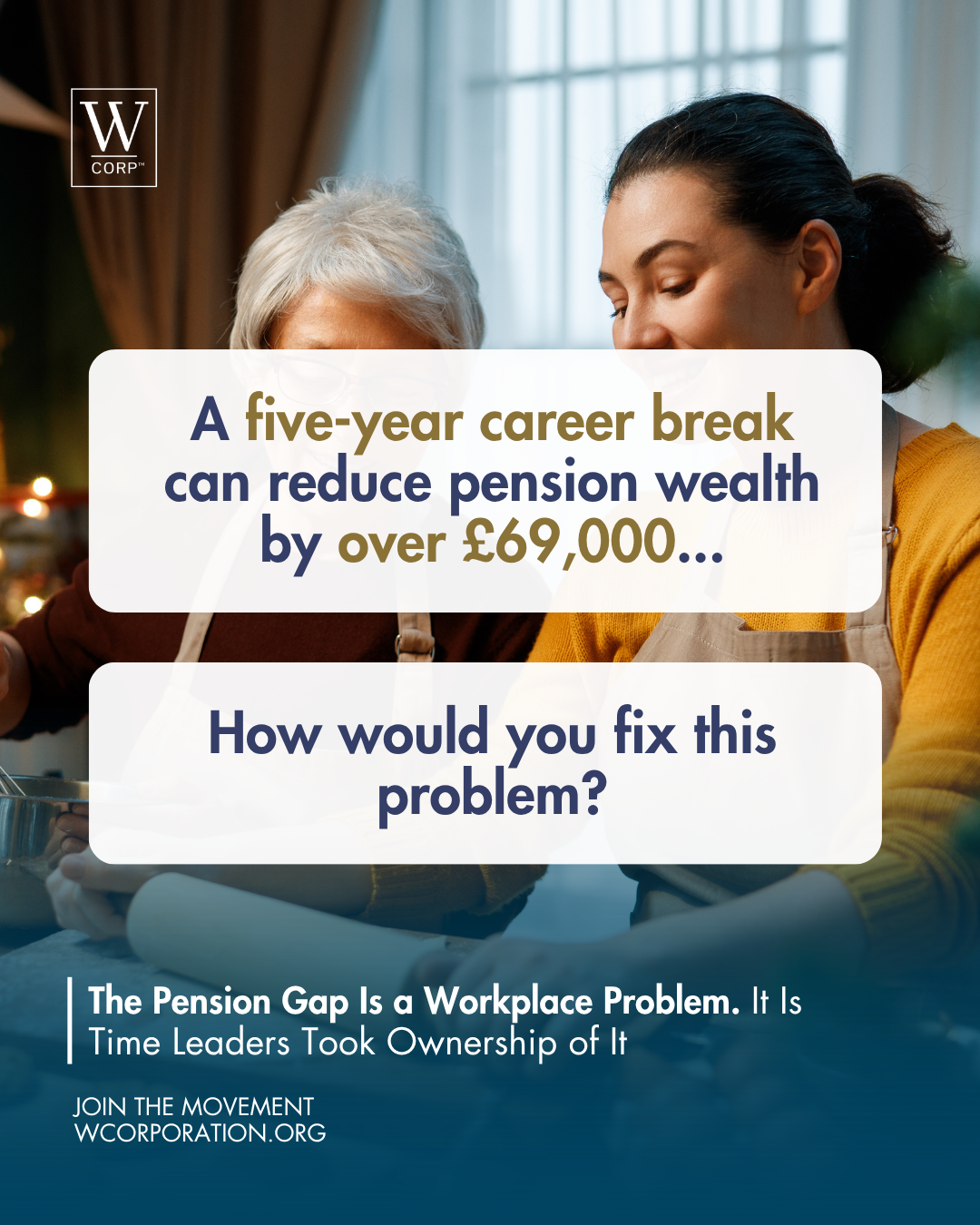
The financial damage begins before women even leave the workplace. 40% of women did not financially plan for their career break. This is not a failure of foresight. It reflects a workplace system where career interruptions are expected but not structurally supported. The “motherhood penalty” costs, on average, £65,618 following the birth of a first child, £26,317 after a second, and £32,456 after a third. And the financial impact does not stop when she steps back from work. A woman taking a five year career break at age 35 reaches retirement with a pension worth £69,380 less than a woman who took no break at all, driven by both missed contributions and lost investment growth.
Then comes the second wave. Research by retirement firm Just Group, reported by MoneyWeek in January 2026, reveals that the “sandwich generation” - those simultaneously raising children while caring for ageing parents - lose an average of £522 a month, or £6,268 a year, in income due to caring responsibilities. Nearly four in ten unpaid carers of elderly relatives have either stopped working altogether or reduced their hours. Among those caring alone, a third have cut back their working hours and 14% have left the workforce entirely. This happens precisely when people are at their peak earning potential, the years when pension pots should be growing fastest.
59% of all unpaid carers in the UK are women. When caring responsibilities fall, they fall disproportionately on her. The compounding effect over a career is severe. By age 59, men hold a median of £75,000 in defined contribution pension wealth, compared to just £19,000 for women, according to Department for Work and Pensions figures. That is not a gap. That is a chasm.
The disparity extends beyond savings totals into quality of life. Only 24% of women are on track for a comfortable retirement, compared to 36% of men, according to the Scottish Widows Women and Retirement Report 2025. The majority of women are not preparing for comfort. They are preparing to fall short.

The mental load and the pension gap move in lockstep. Women carry 70% of the mental load in households, and that invisible labour directly drives career decisions, working patterns and long term financial outcomes.
36% of Women Will Fall Short
More than a third of women face poverty in retirement, according to Scottish Widows. That means falling below the minimum lifestyle pension amount of £13,400 for a single person. That figure covers the basics: food, clothing, transport, holidays and home maintenance. For a significant share of UK women, retirement means not enough. The scale of the national problem sits behind that figure. Nearly 15 million people across the UK are not saving enough for retirement, according to the Department for Work and Pensions. Women are disproportionately concentrated in that 15 million.
Nearly 60% of women have no financial plan for retirement. The Shipp report found this has little to do with indifference and everything to do with mental bandwidth. Women carry the ongoing cognitive labour of anticipating and coordinating care, while spending significantly more time on unpaid work. Financial planning does not get the headspace because the headspace is never available.
Almost two thirds of women have done little or no research on how much they will need in retirement. This is not passive disengagement. It is the predictable result of a system that was never designed with women’s working lives in mind. Until 2012, women were not automatically enrolled into company pension schemes at all. The structural disadvantage was baked in from the start.
One of the clearest levers available sits largely unused. Shared parental leave was designed to redistribute the career break penalty. Yet four in five women who had children in the last ten years never used it, representing around 2.7 million working mothers. The policy exists. Uptake does not.
This is a structural problem that individual women cannot solve alone. It is one that employers are uniquely positioned to address.
The Employer Advantage
Some organisations are already treating the pension gap as a business issue rather than a personal one. Forward-thinking leaders recognise this as a defining feature of an inclusive workplace and a measurable driver of long-term performance. The Scottish Widows Women and Retirement Report 2025 identifies the moments where the pension gap widens fastest: maternity leave, return from career breaks, periods of part-time work and divorce. These are not personal crises. They are structural pressure points that employers encounter every year, in every organisation. Without deliberate support built around them, the gap compounds by default.
Equal parental leave benefits for all parents rank among the most impactful structural changes. When parental leave is genuinely shared, the career break penalty reduces for women and the caring norm begins to shift. Enhanced pension contributions during maternity leave cost less than replacing a senior hire. For any business measuring workplace culture ROI, the return on structural support of this kind is measurable and significant.
Organisations building women friendly workplaces today are retaining talent, closing their pay gaps and protecting their leadership pipelines for tomorrow.
Five Things Employers Can Do Right Now
- Audit your auto-enrolment gap: Which employees fall below the £10,000 earnings trigger? Who is working part-time, and why? Data surfaced at board level changes decisions.
- Match pension contributions during parental and carer leave: Keep contributions going when employees step back temporarily. The compounding effect makes this one of the highest value benefits an employer can provide.
- Build return-to-work support with pensions in mind: Women who return after career breaks often do so at a disadvantage. Proactive pension catch up conversations and access to financial planning reduce the long term gap.
- Normalise equal parental leave: Four in five eligible women never use shared parental leave. Changing that starts with employer culture, not policy leaflets. When leave is genuinely shared, the career break penalty reduces for women and the caring norm begins to shift.
- Measure and report: Track pension pot parity alongside pay gap reporting. What gets measured gets improved.
The Business Case for Acting Now
This is not a retirement industry problem. It is a leadership problem. The career interrupted by inadequate maternity pay, inflexible working and unacknowledged caring costs is the career that retires into poverty. Organisations that close the pension gap are the same ones retaining their best talent, advancing women into senior roles, and building cultures where everyone does their best work.
WCorp Certification gives organisations the framework to assess and address the structural barriers that build gaps like these and to demonstrate, publicly, that they are a workplace where women can build both careers and financial security.
The pension gap is a workplace problem. The workplace is precisely where it must be solved.
How much of your talent’s financial future is your organisation eroding today?
Find out how your organisation measures up. Use WCorp’s ROI Calculator to quantify the cost of inaction, or apply for WCorp Certification to start building a workplace that works for everyone.