
I Want to Talk to You about Periods (The Global Cost of Menstrual Inequity)
Apr 07, 2026
Across the world, women pay a monthly financial penalty for having a body that menstruates.
The cost depends on where they live, how their governments classify menstrual products, and how supply chains are structured. These differences create a quiet but powerful economic burden that affects women’s financial security, workforce participation, and long term earning potential. The business implications are significant. Companies that overlook menstrual inequity are missing a structural barrier that influences productivity, retention, and leadership progression.
Menstrual inequity is an economic issue. It shapes how consistently women can participate in the labour market and how much they can save over a lifetime. It also shapes how organisations attract and retain women in leadership roles. When leaders understand the financial and structural realities women navigate every month, they make better decisions about workplace design, benefits, and culture.
The Price of Menstruation Depends on Your Passport
The cost of menstrual products varies dramatically across countries. The United Kingdom removed its five percent VAT on period products in 2021 after years of campaigning, yet more than 30 countries still classify menstrual products as luxury goods according to the World Bank. This classification increases the cost for consumers and reduces access for low income women.
In the United States, the picture is inconsistent. Some states have eliminated the tampon tax, while others continue to apply sales tax to pads and tampons. The Alliance for Period Supplies found that women in states with a tampon tax pay an average of 150 dollars more per year for menstrual products than women in states without the tax.
In parts of Africa and Asia, imported menstrual products are significantly more expensive due to tariffs and supply chain constraints. UNICEF reports that in some regions, girls miss up to twenty percent of school days each year because they cannot access affordable menstrual products.
These disparities reveal a simple truth. Menstruation is universal. The cost of managing it is not.

The Hidden Productivity Cost
Menstrual inequity affects more than personal finances. It affects productivity and performance at work. A 2024 study in the Journal of Occupational Health found that women experiencing severe menstrual symptoms lose an average of nine days of productivity per year.
A survey by the Chartered Institute of Personnel and Development found that 69 percent of women who experience menstrual pain or heavy bleeding feel less able to concentrate at work.
These are not marginal effects. They influence team performance, project timelines, and leadership readiness. Companies invest heavily in productivity tools and leadership development, yet many overlook a biological reality that affects millions of employees every month.
Who Pays the Price
The economic burden of menstruation falls disproportionately on women, but the cost is shared by employers and the wider economy.
- Women pay financially
Research from Bloody Good Period estimates that the lifetime cost of menstrual products can exceed 18,000 pounds.
- Employers pay through lost productivity
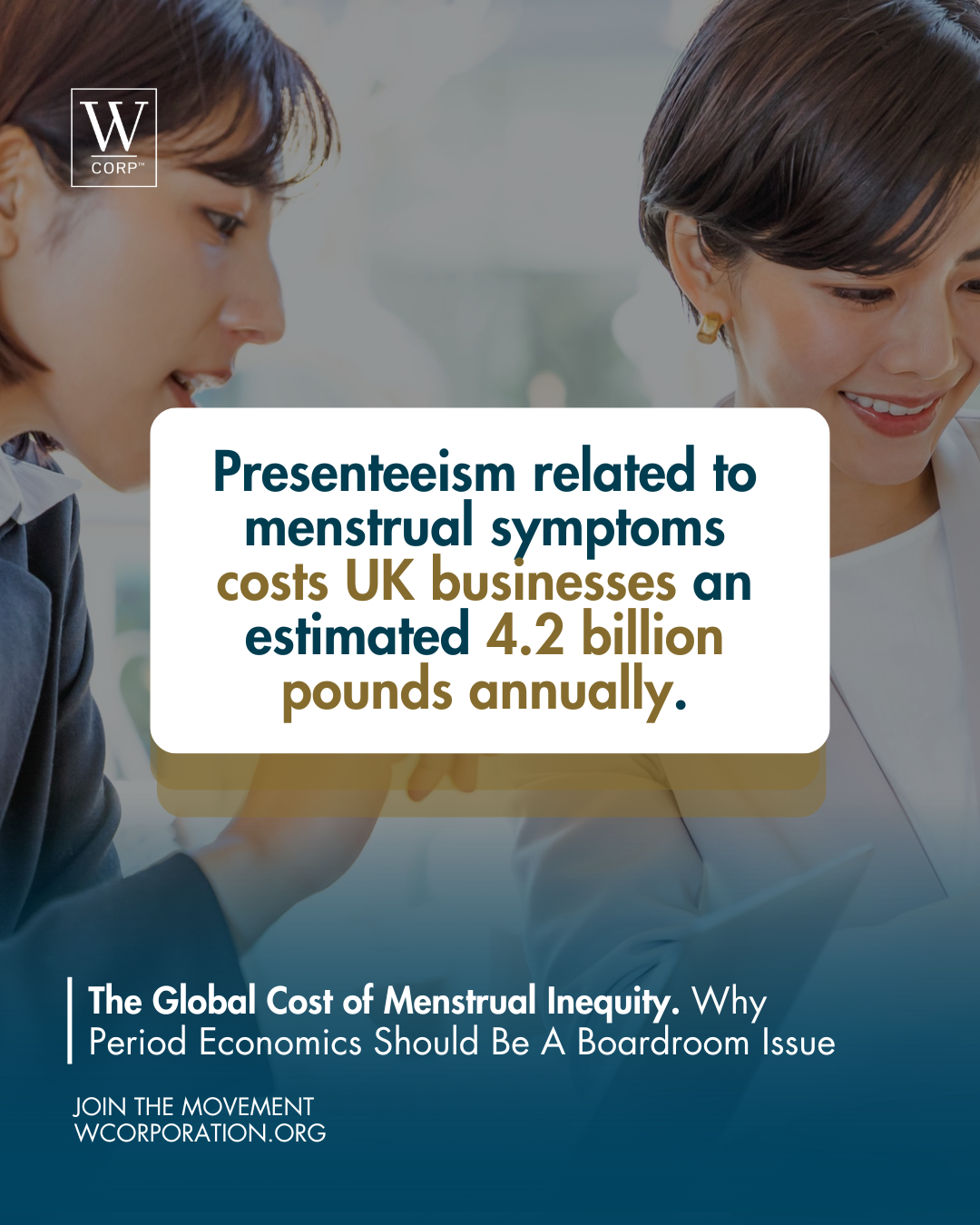
Presenteeism related to menstrual symptoms costs UK businesses an estimated 4.2 billion pounds annually according to the Fawcett Society.
- Economies pay through reduced participation
The World Economic Forum estimates that improving menstrual equity could increase global GDP by up to 0.3 percent by expanding women’s participation in the labour market.
The Invisible Portfolio and the Mental Load
Menstrual inequity is part of a broader pattern. Women carry an Invisible Portfolio of responsibilities that organisations rarely acknowledge. This includes caregiving, domestic labour, emotional labour, and the mental load of managing complex family systems. Menstruation adds another layer. Women plan around their cycles, manage symptoms, and absorb the financial cost of products and healthcare.

When women finally feel seen in conversations about these realities, the emotional release is profound. The weight of being unseen is heavy. When organisations recognise these realities, women feel valued and supported. This strengthens engagement, loyalty, and leadership ambition.
What Leaders Can Do Now
Executives have the power to reduce menstrual inequity and strengthen organisational performance.
1. Provide free menstrual products in the workplace
Scotland became the first country to make period products free in 2022, proving that access is a policy choice.
2. Review benefits and healthcare coverage
Comprehensive coverage for menstrual health improves productivity and reduces absenteeism.
3. Normalise conversations about menstrual health
Leaders set the tone. When menstrual health is treated as a legitimate workplace topic, stigma decreases and support increases.
4. Incorporate menstrual equity into workplace design
Flexible working and autonomy over scheduling help employees manage symptoms without sacrificing performance.
5. Use data to inform decisions
Track absenteeism, presenteeism, and healthcare claims related to menstrual health. Data reveals patterns that intuition cannot.
A Moment for Leadership
Menstrual inequity is a solvable problem. It requires awareness, investment, and leadership commitment. Companies that take this seriously will see measurable improvements in productivity, retention, and employee wellbeing. They will also build workplaces where women can thrive without carrying the financial and emotional burden of being unseen.
The future of work belongs to organisations that understand the full economic reality of their workforce. Menstrual equity is a strategic opportunity to build stronger, more resilient companies and a more equitable world of work.


Read more:
https://www.worldbank.org/en/topic/water/brief/menstrual-health-and-hygiene
https://allianceforperiodsupplies.org/tampon-tax https://www.unicef.org/wash/menstrual-hygiene https://onlinelibrary.wiley.com/doi/10.1002/1348-9585.12345 https://www.cipd.org/en/knowledge/reports/women-health-work https://www.bloodygoodperiod.com/periods-and-poverty https://www.fawcettsociety.org.uk https://www.weforum.org/agenda/2023/03/menstrual-health-economy https://www.gov.scot/news/free-period-products


